It’s clearly “Nimrod”, one of Edward Elgar’s famous Enigma Variations. It was in Dunkirk, and now it is in the Odyssey.
The differences are also obvious: Ludwig Göransson has just used bits and pieces in the Odyssey; sometimes, as shown in Let’s Go Home above, the melody is cut somehow even the motif doesn’t finish yet. Meanwhile in Dunkirk, other then some modifications, Hans Zimmer’s Variation 15 below is still recognicable with the origin.
The motif shows up again in Chasing the Escaping Sun (below). However, the motif is not only fragmented, but also distorted.
SPOILER ALERT after this audio, about the ending of Mr. Nolan’s the Odyssey.
What more interesting is: As this piece of music appear, Odysseus is not returning to Ithaca; he gives up his crown and offer it to Telemachus his son, and set sail to the west with his wife, Penelope.
He is leaving home.
HOME
After the war, soldiers go home. They even want to go home long before the war is over.
So why takes Odysseus 10 years to return home? A lot of people “don’t understand” this, as those memes shown:
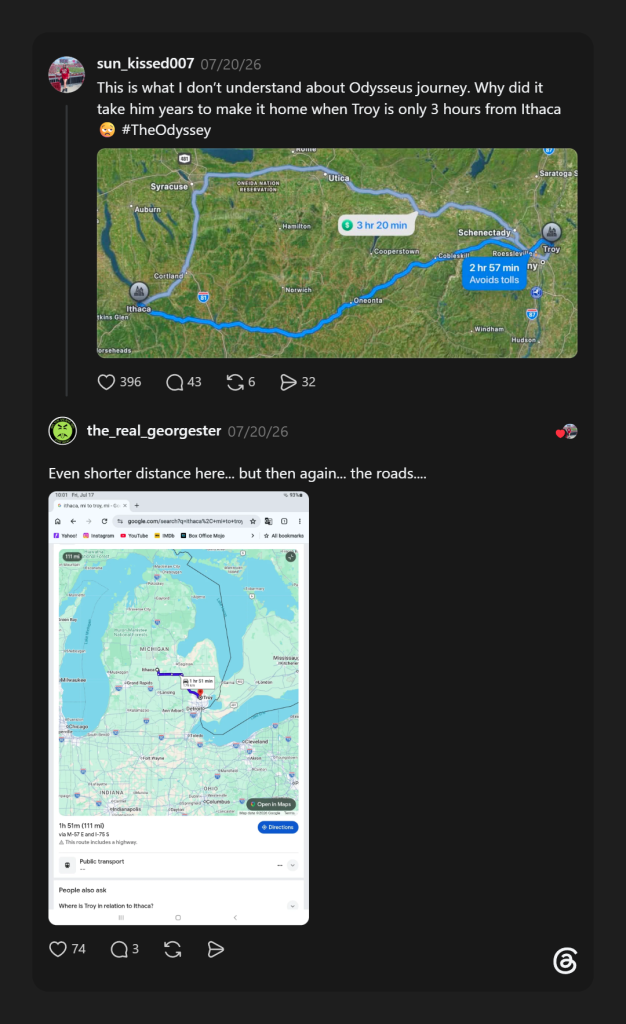
What if home doesn’t give Odysseus comfort and safety, but guilt and saddness?
ATHENA
God certainly has a right to choose which face she would love to show up to the world or to specific person. And with Odysseus, she chooses THIS face:


A slain priestess in the temple of Athena in Troy.
This leave audience a whitespace (留白, Liubai) for intrepretation. She may be Goddess Athena herself, or she may be just Odysseus’ guilt materialized, or both.

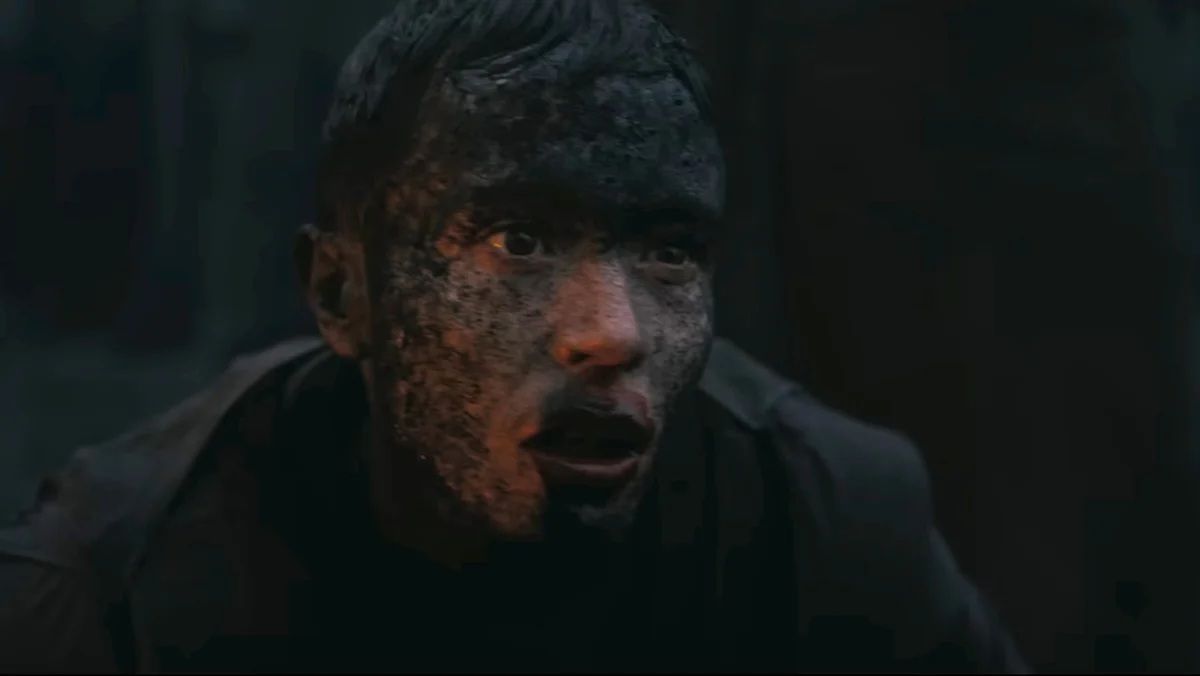
In Oceanus where living people can speak to the dead, the first person Odysseus met is Sinon: the boy he tricked to stay outside the horse, so the boy could lie to the Trojans about the horse. Odysseus, however, also lie to Sinon, without telling him about the soldiers inside the horse.
PHAEACIANS
Certainly Mr. Nolan’s the Odyssey has omitted lots of details from the book, including a fact that the whole journey of Odysseus is mostly his own account to the Phaeacians.
Omitting this is not a big deal. I want to state this, however, is to stress the whole journey may all have been in Odysseus’ head all along. Afterall, he has been lost his way for 10 years (or simply means a long time: Greeks like to symbolize “a long time” as “10 years”, just like the “10-year war” against Troy).
Whether the Trojan War and Odysseus long journey home is fact, an imagination in Odysseus’ mind, the collection of certain oral myths by Homer some 300 years later, or the retelling in Mr. Nolan’s IMAX movie magic after 3 millennia, the story evolves from time to time according to the medium, the creators’ creative process, as well the acceptability of the audience.

According to Wikipedia, the key themes include “the ideas of nostos (νόστος; ‘return’, homecoming), wandering, xenia (ξενία; ‘guest-friendship’), testing, and omens.” I know some scholars do question Mr. Nolan’s adaption; however, I think he contains most of the themes original Odyssey want to discuss, even extends these theme for our time. Either the guests (the 108 suiters of Queen Penelope in Ithaca) or the hosts (first Circe, then Calypso) violate the so-called “Zeus Law”, or xenia represents the collapse of world order, and the threat of “Sea People” has become an oracle of distruction of Odysseus’ world. By using an archeological hypothesis (“Sea People”) of the 12th century Bronze Age Collapse, Mr. Nolan is making his Odyssey a prophecy to today’s world.
President Donald Trump’s foreign policy is simply chasing the money with “democracy”, “freedom”, “justice” as disguise. Thus, if Mr. Nolan’s Odyssey is a criticism to American hegemony, then Elon Musk’s attack on the movie is just hypocritical, with ideology of “anti-woke”, “against DEI” as his disguise.
NOSTOS
Meanwhile, the date the fall of Troy and the massacre of the Trojan people has become the moment Odysseus lost his home forever.
The second person he meets in Oceanus, Agamemnon the “Supreme Commander” of the Greek expeditionary force tells his “homecoming”: he’s killed by his wife, since he’s sacrificed his daughter so the invasion can go smoothly. The moment Agamemnon lost his home forever is when he put Iphigenia on the altar.
The movie toned down Odysseus’ arrogence (not telling Polyphemus after he is safe this time) and add some humanity to his character (plucking the bowstring before striking the arrow to kill, for example). Yet, Odysseus is still a cruel and calculated man (giving his preys a chance to escape, but didn’t give Sinon the same chance). The Greeks may have every reason to punish Troy (snatching Helen from the Spartan King); with all the advantage and benefit of trade Troy has enjoyed, however, all reasons has become excuses. And when his men has become just number of casualties (that’s the reasoning behind his choice between whirlpool Charybdis and the multi-headed monster Scylla), Odysseus’ “humanity” is so laughable.
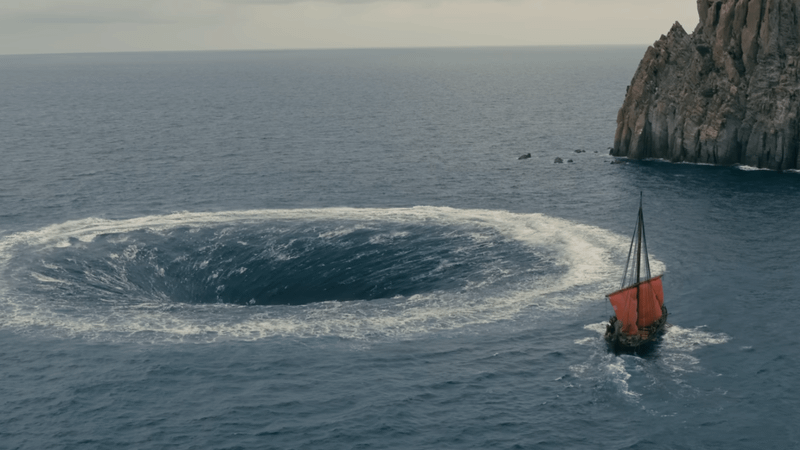
From this perspective, Odysseus’ sin is equal to Agamemnon’s.
As a result, Odysseus cannot go home. He still has to repay his guilt by sailing west to honor his fallen soldiers, with Penelope on his side; he can only seek peace in exile.
He can’t go home, until his soldiers can.
RETURNING HOME
For those British solders on the beach of Dunkirk, home is just one English Channel away. For Odysseus, home is where the sun escapes.
I don’t think I have, so where is yours?