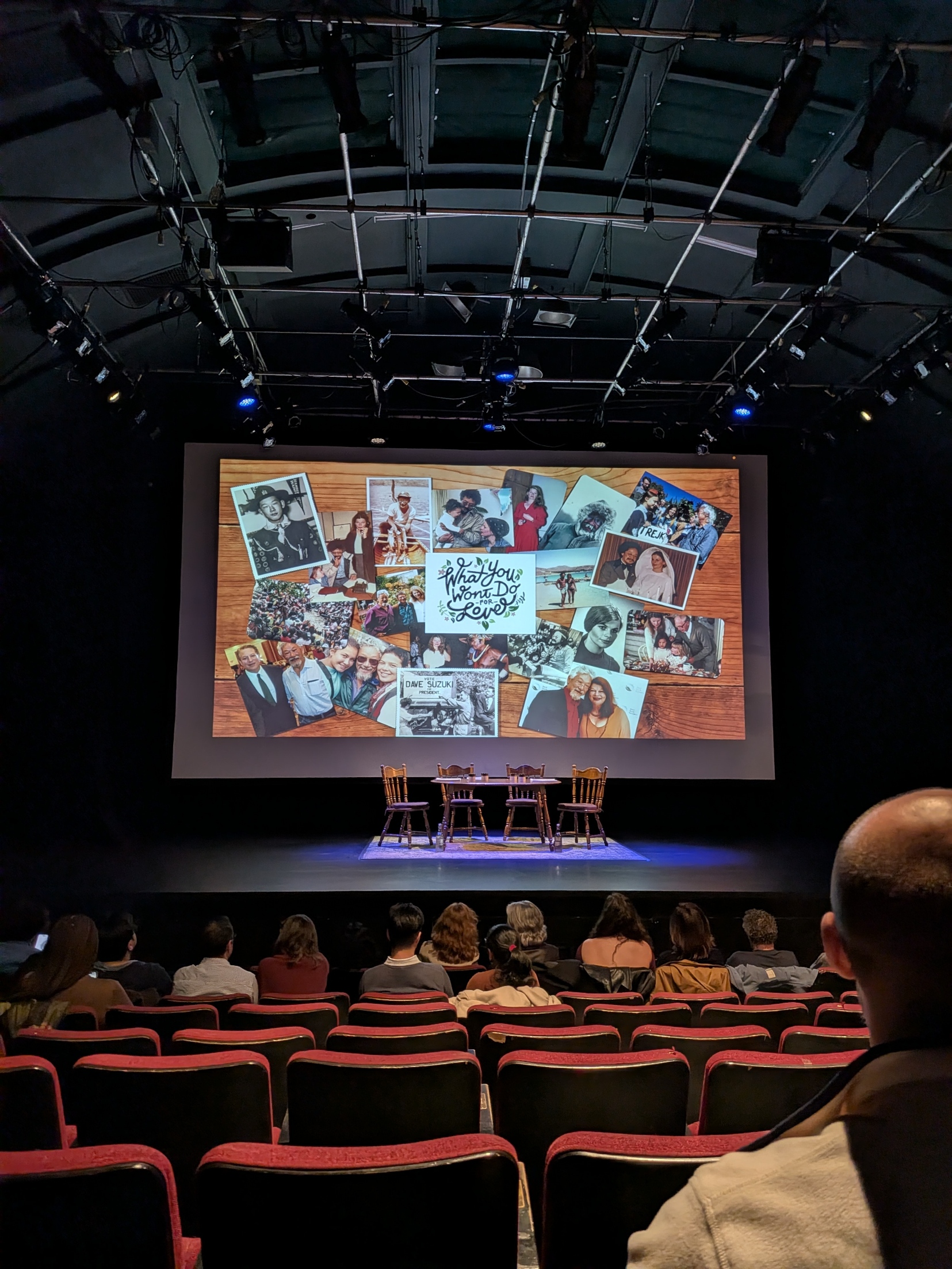

Factory Theatre of Toronto just have a new Artistic Director, and for starting his debut season in such a short period of time (I guess he is on the job for merely weeks), he brings in a play he helped developed in the theatre company he last worked with. David Suzuki is a famous climate change advocate in Canada, and the play is about his relationship with his wife, as well his work to fight for the world and the environment.
He is a headstrong environmentalist, although he may not realize that he has suggested some ideas I actually appreciate more then he does: He said, Leonardo da Vinci may probably the last polymath in history; afterwards, our society has “solely developed our left brain (sorry for me paraphasing)”, i.e., our innovation is mainly on science, finding out fact, and try to conquering the world. Our relationship with nature and the universe is getting ignored.
For example, as a “Sansei” (Third generation Japanese born oversea), he knows the term “いただきます” (Pronounced “itadakimasu”), means “I humbly received.” Food doesn’t come to your table out of lottery, some lives must sacrifice themselves (even plants do have lives, right?) so that they become food for you to consume; therefore, you must receive with gratefulness. As a result, if you become a vegan simply because you “sympathize” some animals are slaughtered to be food on your table, you in fact have no sympathy on life as a whole, since you neglect those “can’t move” as a lifeform (Plants do move, just not in a way you can see them), and you are not respecting the nature.
I don’t even talk about modern Veganism has a vigorous yet twisted-mind promoter: Adolf Hitler (No, I’m not joking); in fact, Nazi Germany is a forerunner to legislation concerning animal cruelty (like, the suffering of lobsters being boiled alive in restaurants). As a result, a lot of white-supremacists just happen to be vegans. In fact, in some ancient Indian or Chinese traditions long before Mahayana Buddhist monks walk the earth and make vegetarianism famous, eating a meat-less diet is more about self cleansing then sympathy on animals; and in Christian tradition, the equivalent is that solemn 40-day liturgical season, called Lent.
The FAR RIGHT
The fundamental weakness of western civilization is empathy. The empathy exploit. They’re exploiting a bug in western civilization which is the empathy response.
Talking about sympathy and Nazism, lately I come across a podcast talking about Elon Musk, and at one point, the guest somehow mentions Musk’s concept on sympathy and empathy. Elon Musk even calling empathy “suicidal”. CNN calling his opinion merely “a wild idea along the same lines as the debunked ‘replacement theory‘.”
“Replacement Theory” is not something I am about to discuss today (at least not right away). What I am thinking of is another “thinker” who has the similar opinion: Charlie Kirk.
I can’t stand the word empathy, actually. I think empathy is a made-up, New Age term that—it does a lot of damage, but it is very effective when it comes to politics. Sympathy I prefer more than empathy.
Both of them somehow also argue that “sympathy” doesn’t equal to “empathy”. According to some common dictionaries, “Sympathy” is “a feeling or expression of sincere concern for someone who is experiencing something difficult or painful”, and “Empathy” is “the ability to share someone else’s feelings or experiences by imagining what it would be like to be in that person’s situation”.
Maybe my English is not that good (I am fluent in English, but after all, it is not my mother tongue). In Chinese, Sympathy is translated as “同情”, and Empathy, “共情”; both “共” and “同” have a meaning of “togetherness” (in fact, “共同” exactly means “together”). As a result, I believe trying to put “Sympathy” against “Empathy” is just playing with words, nothing more.
SYMPATHY as a CHOICE
What make me astonished is not how they “demonizing” empathy (Kirk: it can be psychologically or politically manipulated; Musk: unscrupulous actors weaponize empathy to manipulate well-meaning populations), but whom they choose to have empathy with.
We should have empathy, but that empathy should extend to the victims, not just the criminals. We should have empathy for the people they prey upon.
—Elon Musk, on defining “suicidal empathy”
Going back to that CNN article, in the same interview he talks about “suicidal empathy”, he also said this:
If [the Democrats] had another four years, they would legalize enough illegals in the swing states to make the swing states not swing states,” Musk told Rogan. “They would just, they would be blue states. Then they would … win the presidential; they’d win the House, the Senate and the presidency.
—Elon Musk
“Empathy should extend to victims not criminals” is one thing. The main point is: he considers the immigrants as “criminals” who rape women and kill children.
This is also the rhetoric from Donald Trump.
Why blame immigrants? They have no vote, so they cannot vote him down. Donald Trump and his gangs need scapegoats for their wrongdoing, so that they can swift the blame to someone else but themselves.
This is how the far-right solve problem: they have no solution, so they blame others, and “solve that others”.
This is also how far-left solve problem, too. The difference is, the far-left blame the rich instead of immigrants.
I’m not saying the rich has no responsibility, just like it doesn’t mean there is no criminal among immigrants. To solve the problem, we need a fair tax system to tax the rich, and we need a fair justice system to punish the criminals. Blaming all the rich or all the immigrants can’t solve problem, it just means that you have no solution.
And I believe the rich would rather being taxed instead of having a messy society, just like the immigrant community would rather have the criminals among them be in jail.
Therefore, the problem is neither LEFT nor RIGHT, is that prefix “FAR” before left or right.
NAZI FINALLY SOLVING THEMSELVES
Blaming all immigrants “criminals”, sound familiar?
In fact, this was how Adolf Hitler and his Nazi gangs describe Jews. In their mind, Jews are “criminals, scammers, rats”, confiscated their wealth, stripped off their right, and finally, taken their lives.
What ironic is, in the end when Germany is about to fall, Hitler thought that Germans were worthless just as those Jews, and wanted them all die, just like the Jews did in concentration camps:
In the BBC documentary Rise of the Nazis final episode of Season 3 (Link here is to the TVO version, which can be seen in Canada), the beginning of that final act is described as above. When that anti-MAGA guy on Fox News compares the pro-Trump rally like this, I wonder if he is joking:
Well, in the late 70s, I was a little too young to get involved and go to South America for the Jonestown massacre, but this is as close as I’ll ever get.
[Wait, the Jonestown massacre?]
That’s right. It’s nothing like seeing a cult up front, man!
(I don’t blame him to sell merch of what he said in that interview, though; he’s just follow what Donald Trump is doing)
Today, Donald Trump and his gang may just blame some immigrants as “criminals”; I hope the day you-be-the-blame won’t come.